

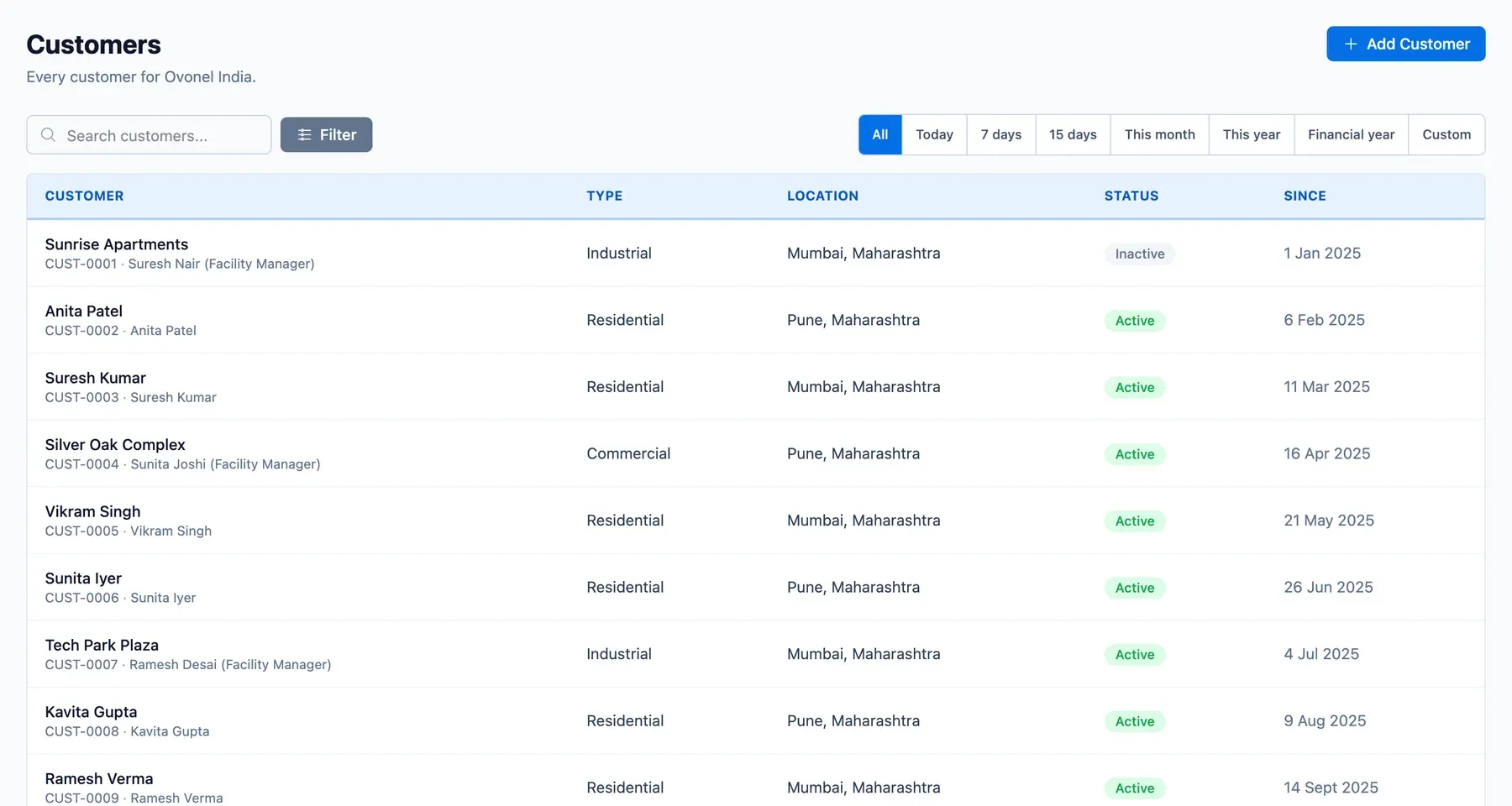
A service business knows its customers through a phone book, a few spreadsheets and the technicians' memory. When the person who knows the customer leaves, so does the knowledge. A single customer record keeps it with the business.
Everything about the customer in one place
- Contacts: the owner, the facility manager, the person who pays, each with a mobile number.
- Sites: every address you serve for them.
- Assets: the equipment at each site, with model, warranty and service history.
- Contracts, jobs, invoices and payments as tabs on the same record.
- Notes, files and tags for anything that does not fit a field.
Keep the data clean
Enquiries and walk-ins create duplicates. The merge tool previews the result, asks for a reason and moves everything to the customer you keep. When a site is sold or a customer's business changes hands, ownership can be transferred so the equipment history stays with the site.
Money stays behind the right role
Without financial access, the customer record hides the outstanding amount and the invoices and payments tabs, so a technician or telecaller sees what they need and no more. See branches, roles and access.
How customers are built up
- A lead converts to a customer, or you add one directly.
- Add sites and equipment found at the survey.
- Attach an AMC contract or log a service request.
- The history grows with every visit, invoice and payment.
Illustrative example: a housing society with six blocks
A lift and CCTV contractor in Mumbai has one customer, the society, with six block sites. Each block lists its lifts and camera systems. When the secretary calls about the lift in Block C, staff see its last service, its open complaint and the contract that covers it.
Who it is for
Every role: office staff, branch managers, technicians and accountants. It is the base for AMC contracts and service requests.